How the Thulla bots think: Easy, Medium and Hard
Every Practice game, and every empty seat at an online table, is played by a bot. They are not machine learning: each one follows hand-written rules, the way a careful human would, and the three levels are the same ideas applied more or less seriously. This page explains what each level does, what it knows and what it does not, so you know what you are playing against.
What a bot is allowed to know
A bot never sees another player's real hand: that would be cheating, and we keep it out of the code on purpose. It gets exactly the information a person at the table has:
- its own hand and the cards it may legally play;
- every card that has become public: played in a finished trick, or picked up in a pile;
- who threw a thulla on which suit. That is the moment a player admits they are out of a suit, and it is the best clue in the game;
- how many cards each player holds;
- which cards a player is known to hold because they picked them up in a visible pile.
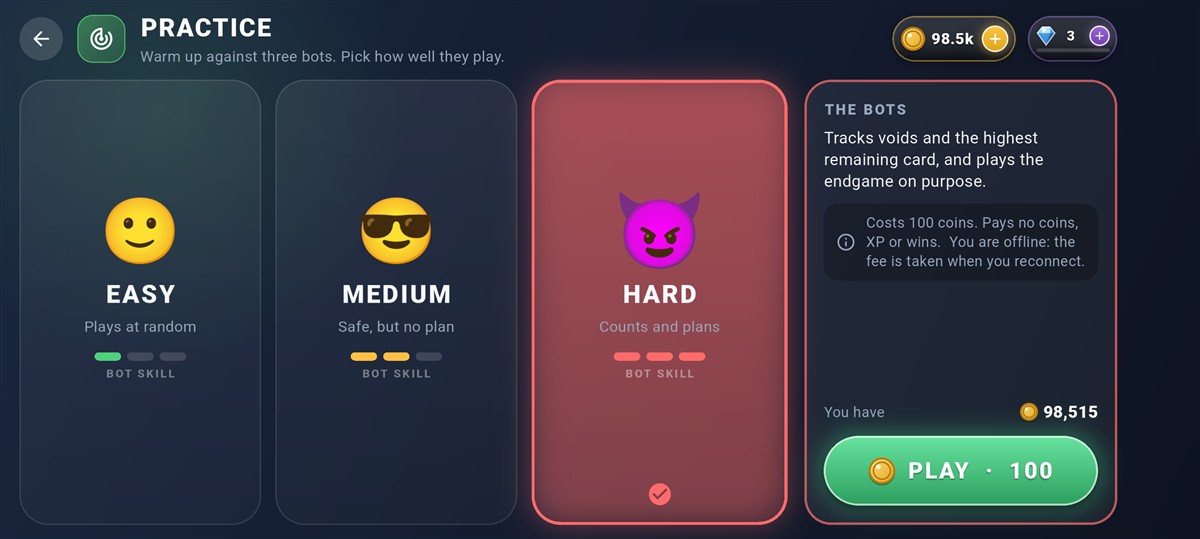
Easy: a random legal card
Easy follows the rules, because it cannot play an illegal card, and inside the rules it picks any legal card at random. It does not count cards or remember who is out of a suit. It plays like a beginner who has just learned what a thulla is. It never asks for a Hand Call.
Medium: sensible habits, no plan
- Leading: it picks the suit that looks safest, one that no opponent is known to be out of and with the most cards still unseen, and plays its highest card of that suit, to shed a dangerous card while leading is cheap.
- Following suit: it plays its lowest card of the led suit, keeping its strong cards.
- On a thulla: when it cannot follow suit it throws its highest card. Because the thrower never picks up, it is the cheapest moment to get rid of a card that could hurt later.
- What it lacks: it never plans the endgame and never works out who holds what. It never asks for a Hand Call.
Hard: it counts and it plans
Hard keeps a model of the cards it cannot see. It starts with the whole deck and subtracts its own hand, the cards that have left the game, the cards on the table, and the cards it knows another player holds. What is left must be in the opponents' hands, and it narrows each card further using who is known to be out of which suit.
Then it scores each legal card by looking one trick ahead:
- How likely is it that this card makes me pick up a pile, and how big would the pile be?
- How likely is it that this card wins the trick, and what would I be forced to lead afterwards?
- How much dangerous strength does this card let me shed? Early in the round it values shedding high cards a lot, and near the end it cares less.
It plays the card with the lowest expected cost. That is why Hard sometimes plays a low card when it could win a trick: winning means leading, and leading can be expensive.
Hand Call: when Hard asks
Only Hard ever asks. It does so when the next player has four cards or fewer, its own hand is no bigger than nine, and the pile it expects to pick up on its lead (plus a penalty for each suit in its hand that is already known to be exposed) outweighs the size of the hand it would take. In plain words: it asks when it is about to be hurt anyway and the hand on offer is small. See the Hand Call guide for what that means for you.
When a bot is the target of a Hand Call it always accepts, at every level. Accepting gives it a safe finish for free.
What the numbers say
We put the bots against each other for 1.7 million rounds, 100,000 per table: see the simulation results. With four players, and a fair share of 25%:
| One … | against three … | Is the Bhabhi |
|---|---|---|
| Hard | Easy | 1.0% |
| Hard | Medium | 2.0% |
| Medium | Easy | 12.1% |
| Easy | Hard | 80.3% |
Hard is much better than Medium, and Medium is much better than Easy. If you can beat Hard in Practice regularly, you are playing very well.
How to beat them
- Against Easy, just play the safe habits from the strategy tips.
- Against Medium, remember it leads its highest card in its safest suit and always plays low when following. You can read its hand a little from that.
- Against Hard, do not make it easy. Keep a suit in common with the last opponent, and remember that Hard will accept your Hand Call every time.
More: simulation results · odds of being the Bhabhi · play against the bots
Frequently asked questions
Do the bots see my cards?
No. A bot is given only what any player at the table can see: its own hand, the cards that have been played or picked up, who threw a thulla on which suit, and how many cards each player holds.
Which bot do I play online?
Matchmade online tables fill empty seats with Hard bots. Practice lets you choose Easy, Medium or Hard.
Will a bot accept my Hand Call?
Always. A bot never refuses a Hand Call, at any difficulty, because accepting guarantees a safe finish.
Do bots ever give up?
Never. Giving up is only for people.
How strong is Hard?
Against three Easy bots, one Hard bot is the Bhabhi in about 1 game in 100. Against three other Hard bots it loses the same 25% as everybody else.
More guides
How to play Thulla (Bhabhi)
The full rules, step by step.
A Thulla round, trick by trick
A worked example: a clean trick, a thulla, and how a round ends.
Thulla, Bhabhi or Bhabi? The names and every term
The names of the game, where house rules differ, and every word explained.
Thulla strategy tips
Habits that keep you from being the Bhabhi.